
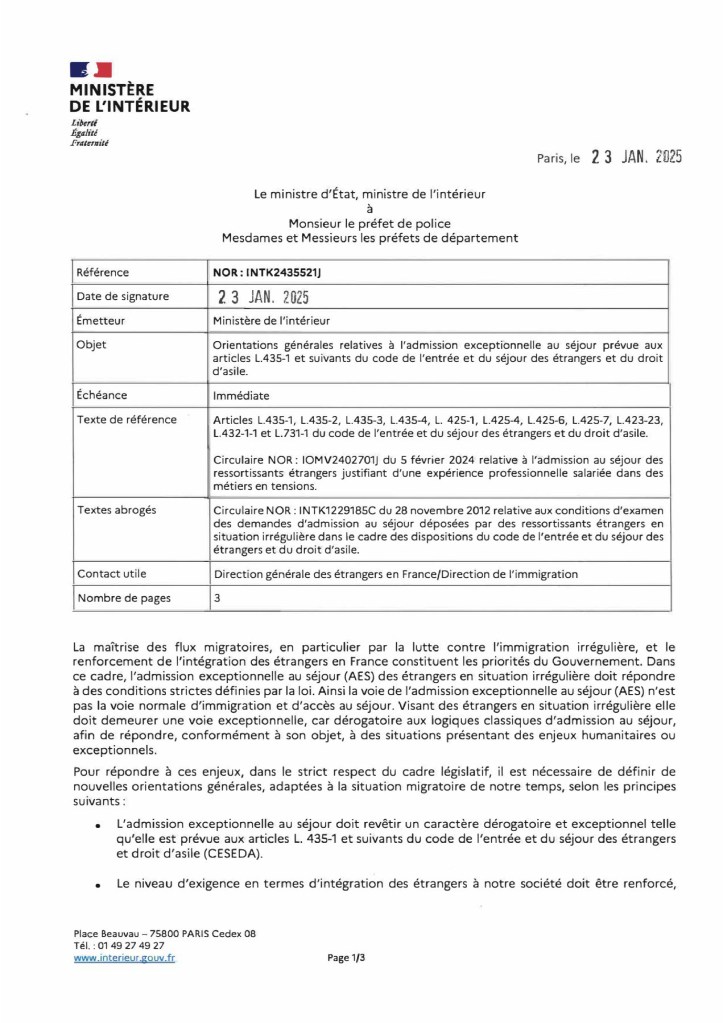
Minister of Interior, Bruno Retailleau, making good on his promise of restricting immigration, especially illegal immigration, in France, announced his new circulaire (Circulaire Retailleau) during a visit to the department of Yvelines last 24 January 2025. Sent to the prefets all over the country, a day before, this new circulaire replaces the Circulaire Valls, which laid out the necessary requirements for the regularization of undocumented immigrants (sans-papiers), in the spirit of promoting a lucid and fair immigration policy. Retailleau’s text, on the other hand, aims to control migratory flows, in particular by combatting illegal immigration. Concretely, this new text prolongs the required duration of stay in France to be able to apply for an admission exceptionnelle au séjour from 5 years to 7 years and requires applicants to have a good grasp of the French language (at least A2 level, with a diploma or certificate from an official institution).
Read the full circulaire below in English and in French :
The control of migration flows, particularly through the fight against irregular immigration, and the strengthening of foreign nationals’ integration in France are key priorities for the Government. In this context, the exceptional admission to residency (AES) of foreign nationals in an irregular situation must adhere to strict conditions defined by law. Thus, AES is not a standard pathway for immigration and residency. As it applies to irregular migrants, it must remain an exceptional measure, as it deviates from the usual rules of residency admission, and should be used strictly for cases with humanitarian or exceptional circumstances.
To address these challenges while strictly complying with the legal framework, it is necessary to establish new general guidelines, adapted to the current migration situation, based on the following principles:
- Exceptional admission to residency must remain a derogatory and exceptional measure, as outlined in Articles L. 435-1 and following of the Code on the Entry and Residence of Foreigners and the Right to Asylum (CESEDA).
- The requirements for foreign nationals’ integration into our society must be reinforced, particularly through their commitment to respecting the principles of the Republic.
- Exceptional admission to residency for an irregular migrant can only be granted in the absence of any threat to public order.
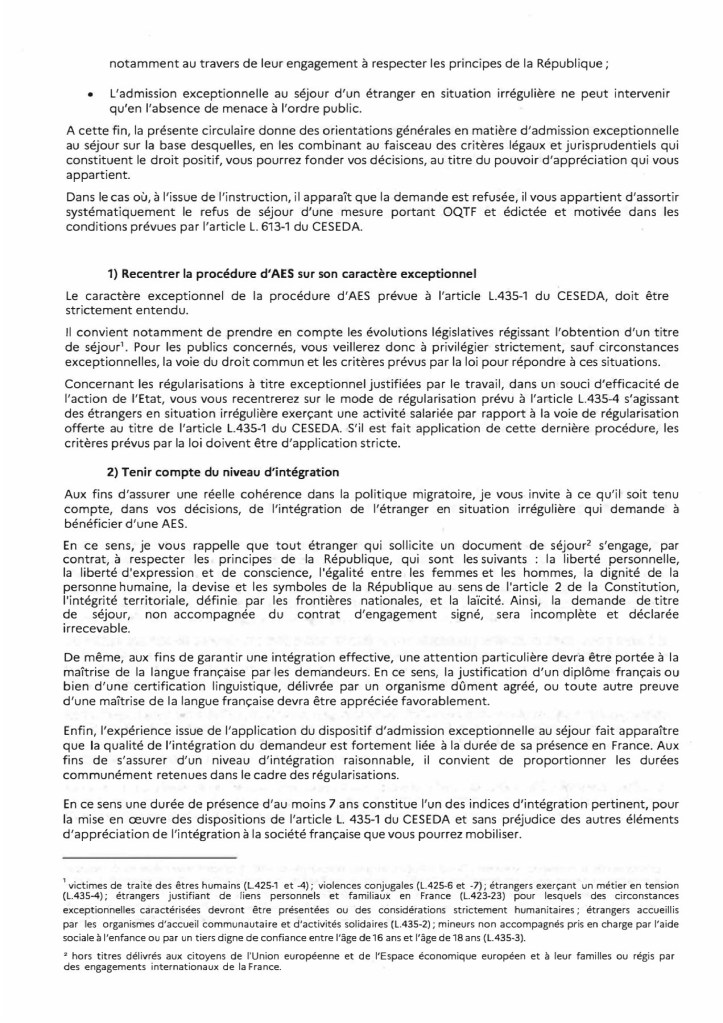
Accordingly, this circular provides general guidelines for exceptional admission to residency. These guidelines, in combination with the set of legal and jurisprudential criteria constituting applicable law, will serve as a basis for decision-making under your discretionary authority.
In cases where, following examination, an application is denied, you must systematically accompany the residency refusal with an Obligation to Leave French Territory (OQTF), issued and justified in accordance with Article L. 613-1 of CESEDA.
1) Refocusing AES on Its Exceptional Nature
The exceptional nature of AES, as stipulated in Article L. 435-1 of CESEDA, must be strictly upheld. Legislative developments governing the issuance of residency permits must be taken into account. For affected individuals, you should strictly prioritize, except in exceptional circumstances, the standard legal pathways and criteria established by law.
Regarding exceptional regularization based on employment, to ensure the efficiency of state action, you should prioritize the regularization mechanism outlined in Article L. 435-4 for irregular foreign workers over the procedure provided in Article L. 435-1 of CESEDA. If the latter procedure is applied, the legal criteria must be strictly enforced.
2) Considering the Level of Integration
To ensure coherence in migration policy, you must consider the level of integration of an irregular migrant applying for AES.
I remind you that any foreign national requesting a residency permit commits, by contract, to respecting the principles of the Republic, which include: personal freedom, freedom of expression and conscience, gender equality, human dignity, the motto and symbols of the Republic as defined in Article 2 of the Constitution, national territorial integrity, and secularism. Any residency request not accompanied by a signed commitment contract will be deemed incomplete and inadmissible.
To ensure effective integration, particular attention must be paid to the applicant’s proficiency in the French language. Possession of a French diploma, an officially recognized language certification, or any other proof of French language proficiency should be viewed favorably.
Furthermore, experience with the AES process has shown that the degree of integration is strongly linked to the length of stay in France. To ensure a reasonable level of integration, the commonly accepted residency duration for regularization must be proportionate. In this regard, a minimum presence of seven years serves as a relevant indicator of integration for applying Article L. 435-1 of CESEDA, without prejudice to other factors demonstrating integration into French society.
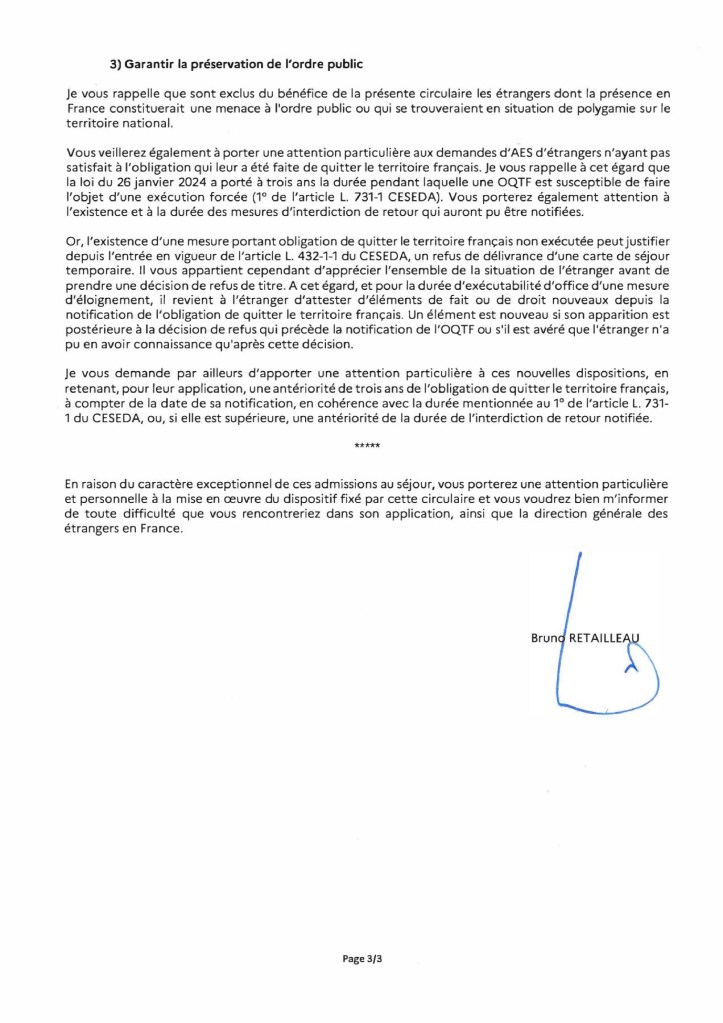
3) Ensuring the Preservation of Public Order
Foreign nationals whose presence in France constitutes a threat to public order or those engaged in polygamy on French territory are excluded from the scope of this circular.
Special attention must also be given to AES applications from foreign nationals who have failed to comply with an obligation to leave French territory. I remind you that the law of January 26, 2024, extended to three years the period during which an OQTF may be subject to forced execution (Article L. 731-1, CESEDA). You must also consider the existence and duration of any return bans that may have been issued.
An outstanding OQTF may, since the implementation of Article L. 432-1-1 of CESEDA, justify the refusal to grant a temporary residence permit. However, you must assess the foreign national’s overall situation before making a final decision. For the enforceable duration of a removal order, the burden is on the applicant to provide evidence of new facts or legal circumstances arising after the OQTF notification. A fact is considered “new” if it emerged after the previous refusal decision or if the foreign national could not have been aware of it at the time.
I request that you pay close attention to these new provisions and, when applying them, uphold the requirement of a three-year period from the date of OQTF notification, in line with Article L. 731-1 of CESEDA, or, if longer, the duration of the notified return ban.
*****
Given the exceptional nature of these residency admissions, you must exercise particular and personal vigilance in implementing the measures set forth in this circular. Please inform me, as well as the General Directorate for Foreigners in France, of any difficulties encountered in its application.
 Espace Philippin
Leave a comment